


Our Socials
LinkedinOctober 13, 2026
Insights from NPL Global 2026 on turning data, technology and human expertise into better credit management.


Using AI is becoming part of everyday business. The harder task is showing what it improves: better decisions, more effective collections, lower costs or a better experience for the customer.
That question was central to the NPL Technology & Innovation panel at NPL Global 2026, held in London on 29–30 September. Jonny Lingvall, Managing Director for Collectia Sweden and Finland, moderated a discussion bringing together perspectives from Synthflow AI, BROCC, Revolut and Accumin Intelligence.
Collectia also contributed findings from our CFO Outlook 2026. Together, the research and discussions highlighted a practical challenge: how to turn AI investment into results that businesses can measure and customers can benefit from.
Three takeaways from the discussion
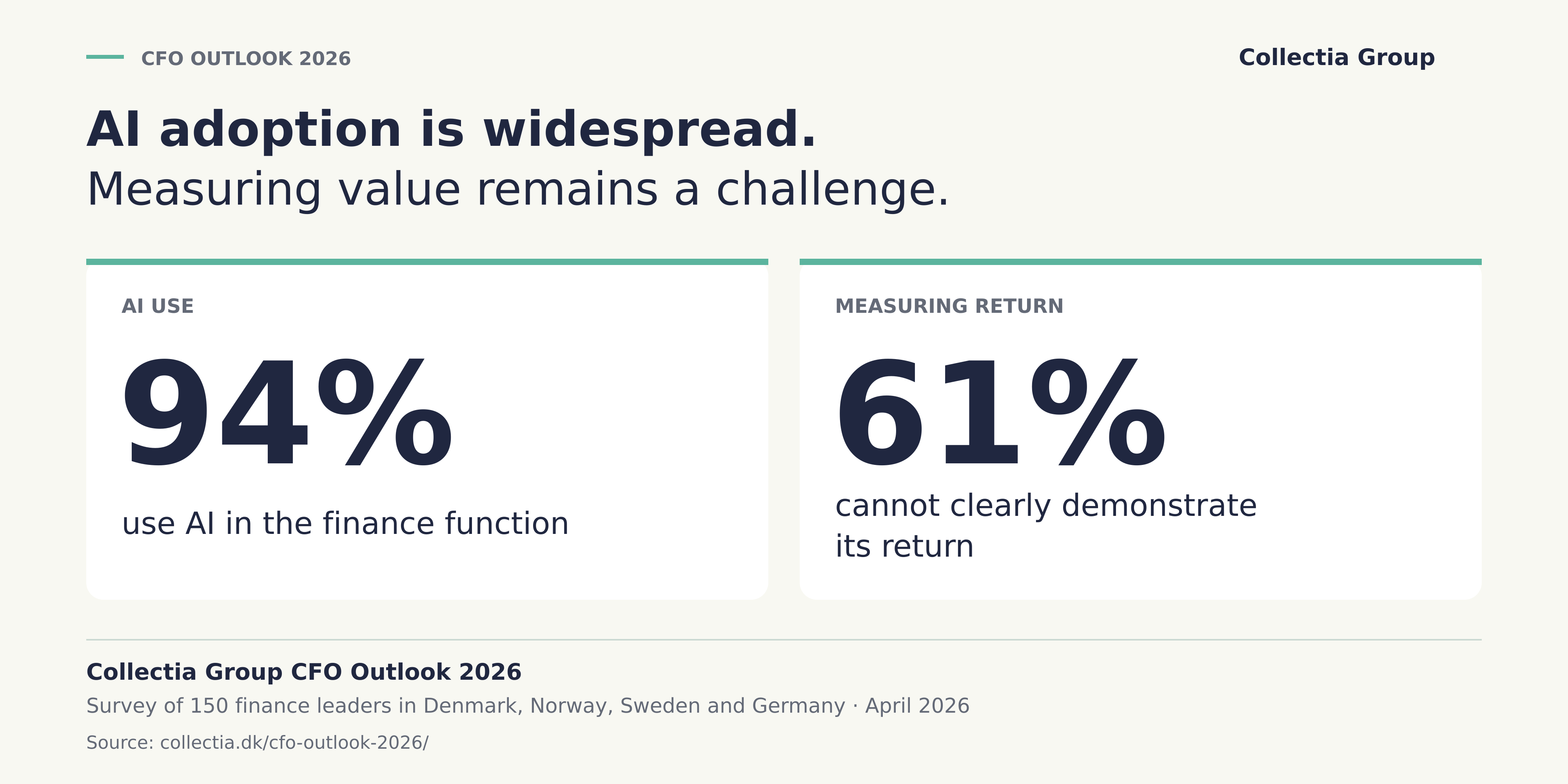
Our Collectia Group CFO Outlook 2026 surveyed 150 senior finance decision-makers in Denmark, Norway, Sweden and Germany. Among those respondents, 94% use AI in the finance function, and half report that it is embedded in key processes. Yet 61% cannot clearly demonstrate its return.
The figures show why adoption alone gives an incomplete picture of progress. A business may have introduced several AI tools without knowing whether they improve the outcomes that matter most.
For finance and credit management teams, the next step is connecting each use of AI to a specific problem. That might mean prioritising overdue accounts more effectively, reducing manual administration or helping employees make better-informed decisions.
One recurring theme in London was the importance of data and business context. Access to a capable AI model is a starting point. Its usefulness depends on the quality, relevance and availability of the information around it.
In loan portfolio transactions, incomplete or inconsistent records can make it harder to assess assets and price risk. In collections, missing payment histories or outdated contact details can limit how well a business understands an individual case.
Different tools also solve different problems. Predicting payment behaviour, supporting a customer conversation and analysing a portfolio each require a clear purpose and suitable information. Choosing the technology comes after understanding the task.
At Collectia, AI-assisted tools include models that help assess the likelihood of payment and support case workflows. These tools inform employees’ decisions, with human judgement and oversight remaining part of the process. This is a practical example of combining technology with knowledge of credit management.
Consider an illustrative example: two customers owe the same amount, and their payments are equally overdue. A strategy based mainly on balance and days past due might treat them in the same way.
But one customer usually pays on time and has missed a payment unexpectedly. The other has a longer history of arrears. One responds to digital messages but rarely answers the phone. The other needs a conversation to explain their circumstances.
Those differences can matter when deciding what to do next. A reminder or a self-service option may be appropriate in one case. A conversation with an employee may be more useful in another.
The panel discussed this move towards a dynamic ‘next best action’: using relevant information to help choose an appropriate step as a case develops, rather than relying only on a fixed customer segment.
Payment history, previous interactions, communication preferences and known circumstances can all contribute to that assessment. The aim is to make each interaction more relevant and to support a realistic path towards resolving the debt.
A promising demonstration does not establish a business case. Before introducing an AI solution, a team needs to define what should improve and how that improvement will be measured.
For a collections operation, relevant measures might include:
The existing process provides the baseline. Results should then be compared under sufficiently similar conditions, so that changes in case mix or customer circumstances are not mistaken for an improvement caused by AI.
Efficiency is one part of the assessment. A lower handling cost may be valuable, but so may reaching customers more effectively or helping employees resolve cases that previously stalled. The business case should capture the outcomes the solution is intended to change, including implementation and ongoing operating costs.

Another practical theme was the gap between a pilot and a solution that works across an organisation. An AI tool may perform well in isolation, then struggle when it needs to connect with customer records, telephony, payment systems and existing workflows.
For example, a recommendation about the next contact becomes less useful if recent payments or previous conversations are missing from the information it receives. Employees also need the recommendation to appear where they actually work, with a clear way to act on it.
Scaling therefore involves more than selecting a model. It requires reliable connections between systems, clear responsibility for data and a process for monitoring performance after deployment. These operational foundations help turn a successful experiment into a dependable part of the service.
Also read: 94% of finance leaders run AI. 61% cannot show what it returned
The discussion also highlighted the role of people. Routine administration and a conversation with someone facing financial difficulties place very different demands on a collections team.
Technology can support predictable tasks and help employees prioritise their attention. Complex circumstances, disputed claims and questions about what a customer can realistically afford still call for careful assessment and dialogue.
That balance needs to be designed into the workflow. Teams should understand what a tool is intended to do, when an employee needs to review its output and how a customer can reach a person when necessary. Appropriate use of customer information and clear accountability are part of that design.
For Collectia, the value of AI lies in supporting better credit management through both technology and experienced people. Financial performance and respectful customer engagement belong in the same conversation.
NPL Global reinforced where we believe the next phase of development should focus: reliable data, useful integration, measurable outcomes and a clear role for human expertise. For businesses choosing a credit management partner, those are practical questions to bring into the discussion.

Explore the findings behind the discussion
Read Collectia Group’s CFO Outlook 2026 for more insights into how finance leaders are working with AI, risk and credit management.

About the panel
NPL Technology & Innovation was moderated by Jonny Lingvall, Managing Director for Collectia Sweden and Finland. He was joined by Sassun Mirzakhan-Saky, CTO & Co-Founder of Synthflow AI; Jaap Boersma, CTO at BROCC; Hardev Tumber, Group Head of Collections & Recoveries at Revolut; and Manuel Cacho García de Oteyza, Global Head of Solutions & Advisory at Accumin Intelligence.
NPL Global, organised by SmithNovak, brings together participants from the international market for loan portfolio investment and servicing, including non-performing loans: loans where borrowers are not meeting their repayment obligations.
https://www.smithnovak.com/conferences/npl-global-2026.html

